The idea
CLIP knows what is in an image but often not how it fits together. Most fixes train it to reject edited "hard negative" captions. GPS-CLIP does the opposite: it pulls the image toward its own grounded structure, its regions, their descriptions, and the relations between them.
Push the image away from edited captions
- Learns to spot word swaps
- Often costs zero-shot and retrieval accuracy
Pull the image toward its own structure
- Learns regions and who-does-what-to-whom
- Keeps or improves zero-shot and retrieval
Scene graphs are used only while fine-tuning. The model you deploy is a plain CLIP dual encoder with the same architecture, the same inputs, and no extra inference cost.
Three losses, one embedding space
An image and its caption are decomposed into regions and a scene graph. Three complementary objectives then act on the same image and text encoders.
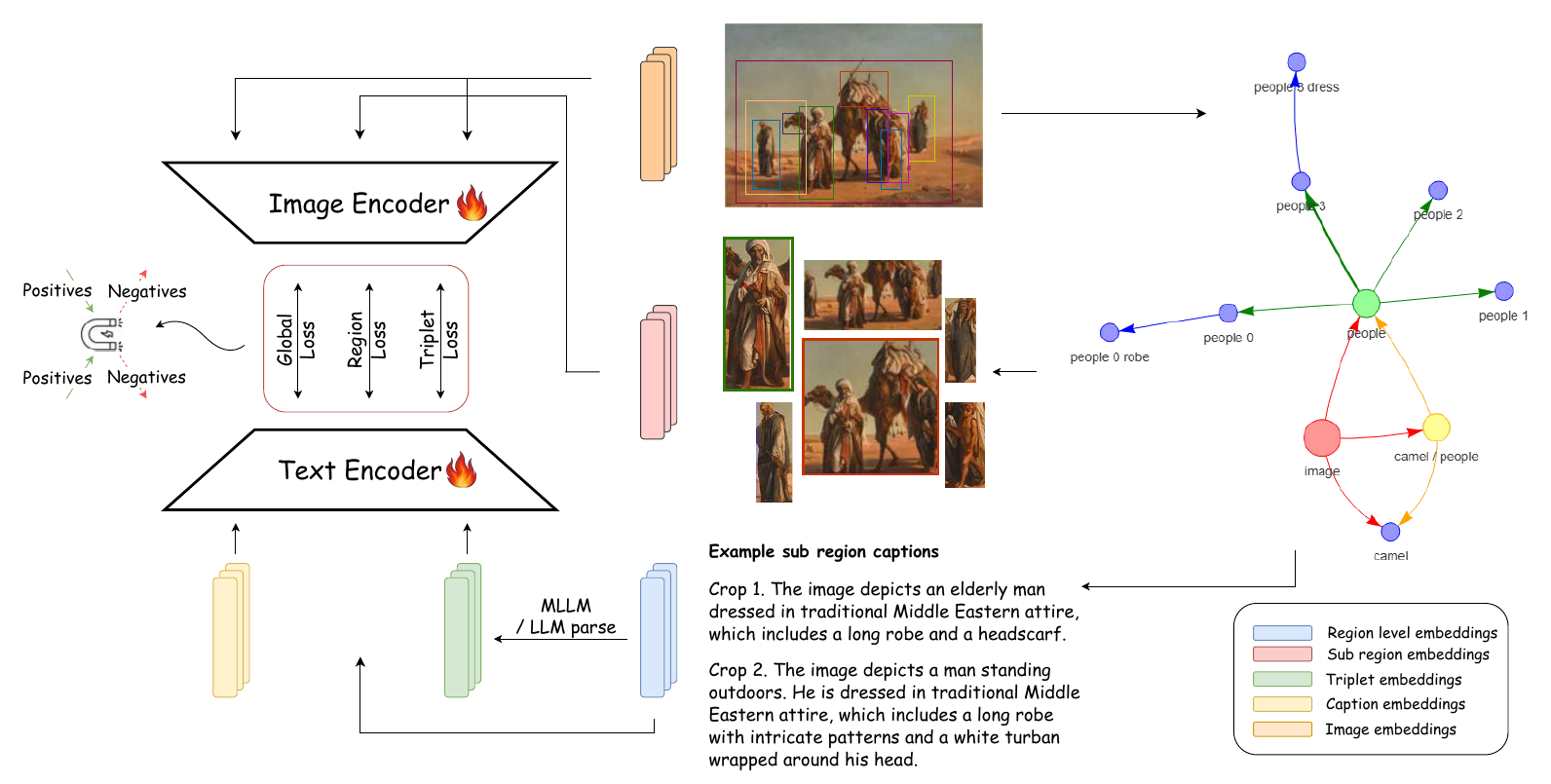
Click a term to focus on it.
Overlap is not a mistake
Regions cut from the same image often overlap. A standard contrastive loss would treat every other region as a negative, punishing the model for noticing that two boxes show the same thing. GPS-CLIP decides by overlap instead.
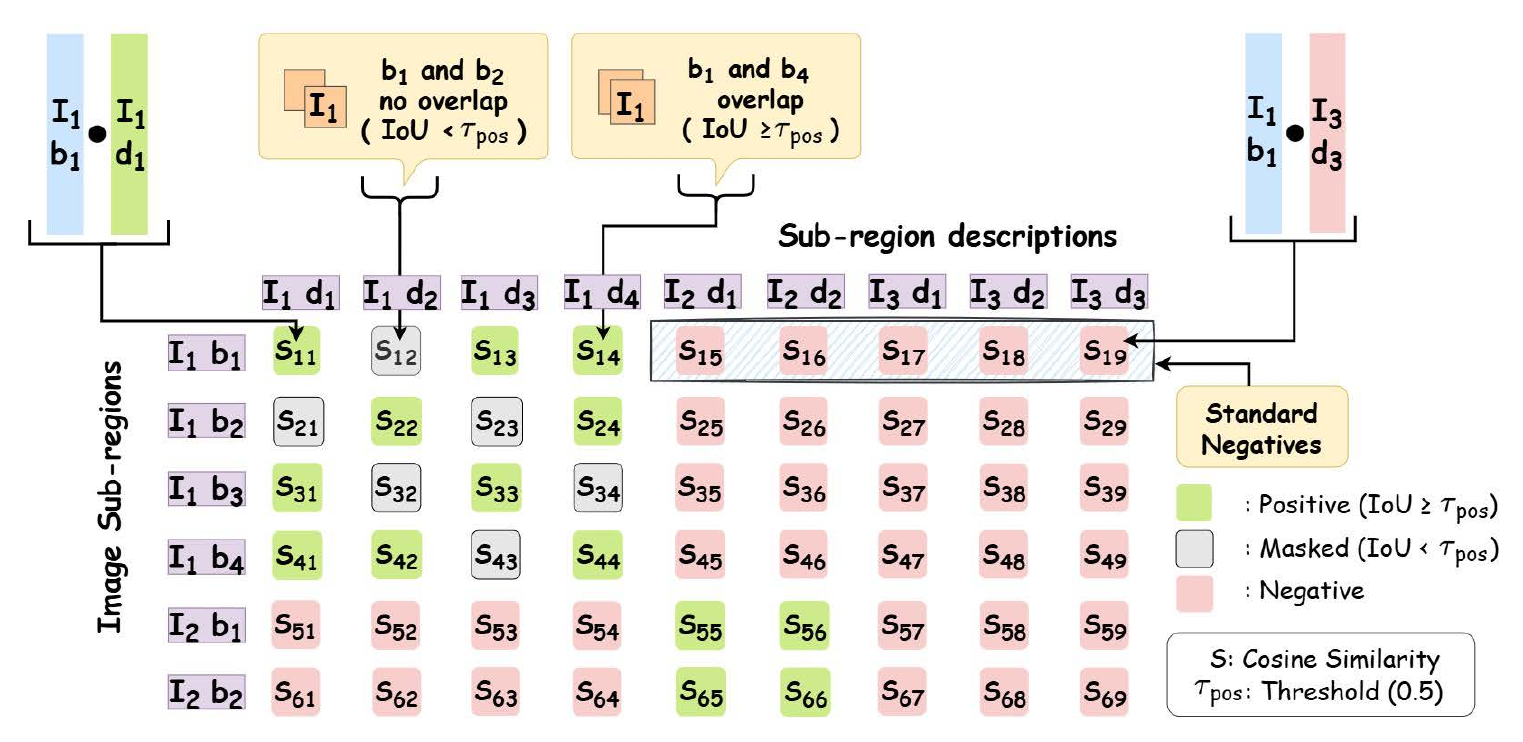
- IoU
- 0.00
- Standard loss
- negative
- GPS-CLIP
Where the gain comes from
Average points gained at each step of the region-loss design, from the ablations.
Results
Fine-tuned from CLIP ViT-B/32, GPS-CLIP improves every benchmark we report, including zero-shot ImageNet and retrieval, which hard-negative methods often trade away.
Accuracy or Recall@1 (%), from Table 1. Comparisons with NegCLIP, TripletCLIP, DAC, CLoVe, CE-CLIP, FSC-CLIP and CLIC are in the paper.
Why it's practical
All the extra machinery lives on the training side. What you deploy is an ordinary CLIP.
At training time
- Scene graphs
- From an offline multimodal model
- Extra losses
- Region + relation
- Noisy graphs
- Degrades gracefully
- Loss family
- InfoNCE or SigLIP
- Scale
- ViT-B/32 to ViT-L/14
At inference time
- Architecture
- Same as CLIP
- Parameters
- +0
- Latency
- Unchanged
- FLOPs
- Unchanged
- Inputs
- Image + text only
Use GPS-CLIP
GPS-CLIP loads like any CLIP checkpoint. Swap it into existing code without other changes.
Cite
@inproceedings{udai2026gpsclip,
  title     = {Beyond Hard Negatives: Grounded Positive Supervision for Compositional {CLIP}},
  author    = {Udai, Harsh and Mopuri, Konda Reddy and Balasubramanian, Vineeth N.},
  booktitle = {Advances in Neural Information Processing Systems (NeurIPS)},
  year      = {2026}
}